
Could irregular periods, acne and facial hair be PCOS? They can be. Periods that are repeatedly irregular, together with acne or extra facial or body hair, are a common pattern in PCOS, a hormonal condition. But each of these signs has other causes too, so symptoms alone cannot confirm PCOS. A doctor’s assessment can.
A note on names. PCOS (polycystic ovary syndrome) has a new international name, polyendocrine metabolic ovarian syndrome (PMOS), agreed in a consensus published in The Lancet in May 2026 and endorsed by the American Society for Reproductive Medicine. It is the same condition, and current guidance still applies. The new name reflects its effects on hormones and metabolism, and the fact that the ovaries do not contain true cysts. Many people in India say PCOD, another name for the same condition; international guidelines do not describe a separate, milder PCOD. We use PCOS here because it is more familiar.
Sources: The Lancet 2026: PCOS renamed PMOS (global consensus) (opens in a new tab) · MCHRI: PCOS to PMOS terminology update (opens in a new tab) · ASRM: PCOS is now PMOS (opens in a new tab) · Monash MCHRI: PMOS guideline (opens in a new tab) · MedlinePlus: Polyendocrine metabolic ovarian syndrome (PCOS) (opens in a new tab) · J Obstet Gynaecol India 2016: PCOS nomenclature review (opens in a new tab)
When to get checked: the short version
- Book an appointment for irregular periods over several months, more than 3 months without a period (when not pregnant), no periods by 15, or irregular periods with acne, unwanted hair or hair thinning.
- Ask for an urgent appointment if hair growth or other changes appear suddenly or worsen quickly, or if bleeding soaks a pad every hour for 2 to 3 hours, lasts more than a week, or leaves you weak or light-headed.
- Get emergency help for tummy pain with unusual bleeding after a missed period, or heavy bleeding that makes you faint. See the full list.
Which symptoms can suggest PCOS?
PCOS varies from person to person: not everyone has every sign, symptoms can be mild or more noticeable, and they can change over time. Signs that can occur include:
Irregular, infrequent or absent periods
- Why it can point to PCOS
- Irregular ovulation is a core feature of PCOS.
- What it cannot prove on its own
- Pregnancy, stress, thyroid problems and breastfeeding also upset cycles, and teenage cycles are often irregular.
Acne or oily skin
- Why it can point to PCOS
- High androgens (hormones such as testosterone, which everyone makes) can cause persistent acne.
- What it cannot prove on its own
- Acne is very common, especially in teenagers, and on its own is a weak sign.
Unwanted facial or body hair
- Why it can point to PCOS
- Coarse, dark hair on the face, chest, tummy or back (hirsutism) is a clearer sign of high androgens than acne or hair thinning.
- What it cannot prove on its own
- Hair growth often runs in families, and sometimes has another cause.
Thinning scalp hair
- Why it can point to PCOS
- High androgens can cause female-pattern hair thinning.
- What it cannot prove on its own
- Illness, stress, weight loss and low iron also thin hair.
Weight changes, or dark skin patches on the neck or armpits
- Why it can point to PCOS
- These can reflect insulin resistance (the body responding less well to insulin), which is common in PCOS.
- What it cannot prove on its own
- PCOS occurs at every body size, and dark patches have other causes.
| Symptom | Why it can point to PCOS | What it cannot prove on its own |
|---|---|---|
| Irregular, infrequent or absent periods | Irregular ovulation is a core feature of PCOS. | Pregnancy, stress, thyroid problems and breastfeeding also upset cycles, and teenage cycles are often irregular. |
| Acne or oily skin | High androgens (hormones such as testosterone, which everyone makes) can cause persistent acne. | Acne is very common, especially in teenagers, and on its own is a weak sign. |
| Unwanted facial or body hair | Coarse, dark hair on the face, chest, tummy or back (hirsutism) is a clearer sign of high androgens than acne or hair thinning. | Hair growth often runs in families, and sometimes has another cause. |
| Thinning scalp hair | High androgens can cause female-pattern hair thinning. | Illness, stress, weight loss and low iron also thin hair. |
| Weight changes, or dark skin patches on the neck or armpits | These can reflect insulin resistance (the body responding less well to insulin), which is common in PCOS. | PCOS occurs at every body size, and dark patches have other causes. |
Low mood, tiredness and difficulty getting pregnant can also occur. None of these signs is specific to PCOS, so a list can raise the question but not answer it.
Sources: WHO: Polycystic ovary syndrome (opens in a new tab) · NHS: PMOS (opens in a new tab) · International PCOS guideline 2023 (Human Reproduction) (opens in a new tab) · NHS: Hirsutism (opens in a new tab) · MedlinePlus: Excessive or unwanted hair in women (opens in a new tab) · NHS: Acne (opens in a new tab) · NHS: Hair loss (opens in a new tab)
What counts as an irregular period?
Count a cycle from the first day of one period to the first day of the next. From more than three years after your first period, whatever your age, the international guideline calls cycles irregular if they are usually shorter than 21 days or longer than 35 days, or there are fewer than eight periods a year. Any single gap of more than 90 days also counts.
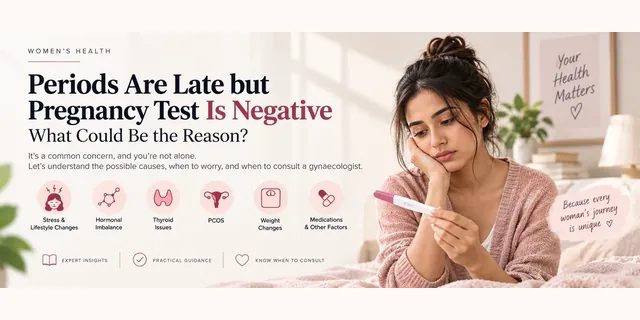
One late period after stress, illness or travel is common and is not a pattern. Note each period’s start date, length and heaviness in a diary or app. If your period is late and you could be pregnant (even if you used contraception), take a pregnancy test first. If it is negative and your period still has not come, repeat the test after 48 hours. Our guide to a late period with a negative pregnancy test explains the common reasons.
If you are a teenager
In the first year after your first period, irregular cycles are normal. From one to three years after it, cycles count as irregular if they are usually shorter than 21 days or longer than 45 days. After the first year, see a doctor if you go more than 90 days without a period. Also see a doctor if your periods have not started by 15, or within three years of your breasts starting to develop. Irregular cycles alone do not mean you have PCOS.
Sources: International PCOS guideline 2023 (Human Reproduction) (opens in a new tab) · NHS: Irregular periods (opens in a new tab)
Could it be something else?
Several other conditions can look similar, and ruling them out is part of the diagnosis:
- Pregnancy or breastfeeding. If you could be pregnant, a pregnancy test comes first.
- Thyroid problems, whether underactive or overactive.
- A raised prolactin level, which can upset periods and sometimes causes a milky nipple discharge.
- Stress, illness, or not eating enough for how active you are, which can pause ovulation at any body size, as can intensive exercise or sudden weight loss.
- Hormonal contraception and some medicines. A few, such as steroids and some epilepsy medicines, can cause hair growth.
- Approaching menopause from the mid-40s or, less commonly, an earlier slowing of the ovaries.
- Rarer hormone conditions, such as non-classic congenital adrenal hyperplasia (usually checked with a blood test as part of the assessment) or Cushing’s syndrome (checked if there are signs of it). If symptoms are severe or develop quickly, doctors look further for other rare causes.
Some fine facial hair is normal, and hair patterns run in families. What matters is a change, or hair growth that bothers you, however mild it may look to others.
Sources: NHS: Missed or late periods (opens in a new tab) · Guideline diagnostic algorithm (MCHRI) (opens in a new tab) · MedlinePlus: Absent menstrual periods (opens in a new tab) · MedlinePlus: Prolactinoma (opens in a new tab) · Endocrine Society: Functional hypothalamic amenorrhoea guideline (opens in a new tab) · NHS: Hirsutism (opens in a new tab) · MedlinePlus: Excessive or unwanted hair in women (opens in a new tab)
How is PCOS diagnosed?
There is no single test or home checklist for PCOS. In adults, a doctor diagnoses it when at least two of these three features are present, after ruling out other causes:
- 1Irregular cycles or irregular ovulation.
- 2Signs of high androgens, on examination (mainly unwanted hair, but also acne or hair thinning) or in a blood test.
- 3A polycystic ovary appearance on ultrasound or, in adults only, a raised level of the hormone AMH (anti-Müllerian hormone) in a blood test instead of a scan.
Your doctor will ask about your cycles, symptoms, medicines, family history, mood and pregnancy plans, and may examine you. They should ask before discussing or measuring your weight. Blood tests are chosen to suit you, and may include testosterone plus thyroid, prolactin and other hormones to rule out other causes. If you take the contraceptive pill, ask your doctor before stopping it for tests. Blood sugar and cholesterol are checked at diagnosis, whatever your weight.
Insulin tests and the ratio of LH to FSH (two hormones that signal the ovaries) are not used to diagnose PCOS. AMH is never used on its own, as levels vary with age, body size and pill use, and the pill also makes testosterone results hard to read. So one blood result, like one scan, cannot settle the diagnosis.
Does everyone need an ultrasound?
No. If you are an adult with both irregular cycles and signs of high androgens, you do not need an ultrasound or AMH test for the diagnosis. When a scan is used, the “cysts” of the old name are really small follicles (fluid-filled sacs holding developing eggs). On a modern internal scan, the adult threshold is 20 or more in at least one ovary; with a scan over the tummy, doctors look mainly at ovary size. An internal scan is only done if you are comfortable with it. Some women without PCOS also have many follicles, so a scan report alone, even one that says “PCOD” or “polycystic ovaries”, is not a diagnosis.
Diagnosis in teenagers and young women
If you are a teenager, PCOS is diagnosed only when you have both irregular cycles (judged by time since your first period) and signs of high androgens, such as marked unwanted hair, severe acne or a raised level in a blood test, and other causes have been ruled out. Ultrasound and AMH are not used for diagnosis in teenagers, or in young women within about eight years of their first period, because ovaries at this stage naturally have many follicles.
If you have only one of those two features, you may be told you are “at increased risk”. This is not a diagnosis: your symptoms can still be treated, and your doctor should check again at or before about eight years after your first period.
Sources: International PCOS guideline 2023 (Human Reproduction) (opens in a new tab) · Guideline diagnostic algorithm (MCHRI) (opens in a new tab) · BMC Medicine 2025: PCOS recommendations for adolescents (opens in a new tab) · ASRM ReproductiveFacts: PMOS (formerly PCOS) fact sheet (opens in a new tab) · JAMA Internal Medicine 2026: Ovarian cysts in PCOS (opens in a new tab)
Can you have PCOS without cysts, at a lower weight or with regular periods?
Without cysts on a scan?
Yes. The ovary appearance is only one of three features, and WHO notes that some women with PCOS do not have polycystic ovaries.
At a lower weight?
Yes. PCOS occurs at every body size; at a lower weight it is sometimes called “lean PCOS”. Insulin resistance can occur at a lower weight too, so the same checks apply, and weight is never a reason to dismiss your symptoms.
With regular periods?
It is possible. Regular periods do not always mean you are ovulating, so an adult with regular cycles can still be diagnosed: for example, with signs of high androgens plus a polycystic ovary appearance, or with signs of high androgens plus a blood test showing ovulation is not happening. Your doctor will decide whether that test is needed.
Sources: WHO: Polycystic ovary syndrome (opens in a new tab) · International PCOS guideline 2023 (Human Reproduction) (opens in a new tab) · Human Reproduction 2016: Insulin resistance in PCOS (opens in a new tab) · J Diabetes Metab Disord 2018: Lean PCOS review (opens in a new tab)
How can treatment help?
There is no cure for PCOS, but its symptoms can be managed well. Treatment is a shared decision, based on what bothers you most, your health, and whether you want a pregnancy now, later or not at all.
- Healthy habits at any size. Activity you enjoy and balanced meals benefit your health, even without any change in weight. There is no single “PCOS diet”, and weight loss is not a condition for getting care.
- Periods and the womb lining. If it is suitable for you, the combined contraceptive pill can regulate cycles. Very long gaps between periods are worth discussing, as there are straightforward ways to protect the womb lining.
- Acne and unwanted hair. The pill, skin treatments and laser hair reduction from a qualified provider can help, though results take several months. If unwanted hair has not improved enough after at least six months, your doctor may discuss adding an anti-androgen medicine (one that blocks the effects of androgens). These are used only with reliable contraception, as they are unsafe in pregnancy.
- Metabolic health. PCOS raises the chance of type 2 diabetes at any body size, so blood sugar, blood pressure and cholesterol are checked from time to time. Metformin suits some people.
- Emotional wellbeing. Low mood, anxiety and worries about appearance or food are common, and deserve care too. If you are struggling, India’s free Tele MANAS helpline (14416 or 1800-89-14416) is open 24 hours a day.
Be wary of detox teas, supplements or plans that promise to cure or reverse PCOS in a set time, and tell your doctor about any supplement you take. Learn more about PCOS and hormonal health care.
If you are trying to conceive
PCOS does not mean you cannot get pregnant: pregnancy can often be achieved, naturally or with treatment. When ovulation needs help and there is no other fertility problem, the international guideline recommends letrozole tablets as the first choice, although it is used off-label in many countries. Your doctor will choose the right ovulation medicine, check first that you are not already pregnant, and monitor the treatment. Never take these medicines on your own. A pre-pregnancy check of blood sugar and blood pressure is also recommended. See fertility and pre-conception care.
Sources: WHO: Polycystic ovary syndrome (opens in a new tab) · International PCOS guideline 2023 (Human Reproduction) (opens in a new tab) · NHS: PMOS (opens in a new tab) · DGHS (MoHFW): National Mental Health Programme, Tele MANAS (opens in a new tab)
When should you see a gynaecologist?
Book an appointment
- Irregular periods for several months, using the cycle lengths above.
- More than 3 months without a period, and you are not pregnant.
- No periods by the age of 15.
- Irregular periods with acne, unwanted hair growth or scalp hair thinning.
- Irregular periods while you are trying, or planning, to get pregnant.
- Symptoms affecting your mood, confidence, studies, work or relationships.
You do not need to wait for three missed periods if something else is worrying you.
Ask for an urgent appointment
- Thick, dark hair suddenly growing on your face or body, or symptoms getting worse quickly.
- A deepening voice, or muscles getting bigger.
- Bleeding that soaks a pad every hour for 2 to 3 hours, lasts more than a week, or leaves you weak or light-headed.
Rapid changes need checks for other hormone causes, and heavy bleeding needs its own assessment rather than being put down to PCOS.
Get emergency help now
- Pain in your tummy or pelvis with unusual vaginal bleeding, or pain at the tip of your shoulder, when you have missed a period or could be pregnant. These can be signs of an ectopic pregnancy (a pregnancy growing outside the womb).
- Sudden, severe tummy pain, or feeling very dizzy or faint.
- Heavy bleeding with fainting, chest pain or breathlessness, or bleeding that will not stop.
Go to the nearest hospital emergency department, or call 112, India’s single emergency number for police, fire and ambulance help. Do not put these symptoms down to PCOS.
Sources: NHS: Missed or late periods (opens in a new tab) · NHS: Irregular periods (opens in a new tab) · NHS: PMOS (opens in a new tab) · NHS: Hirsutism (opens in a new tab) · International PCOS guideline 2023 (Human Reproduction) (opens in a new tab) · MedlinePlus: Vaginal or uterine bleeding (opens in a new tab) · MedlinePlus: Recognising medical emergencies (opens in a new tab) · NHS: Bleeding between periods (opens in a new tab) · NHS: Ectopic pregnancy (opens in a new tab) · MHA: Emergency Response Support System (112) (opens in a new tab) · Gurugram Police: Dial 112 control room (opens in a new tab)
What should you bring to your appointment?
- 1Your period dates for recent months, with how long and how heavy each was.
- 2A symptom timeline: when acne, hair or weight changes began, and how quickly they are changing.
- 3Your medicines and supplements, including contraception and acne treatments.
- 4Earlier reports, such as blood tests and scans.
- 5Your pregnancy plans: now, later or not at all, as this shapes treatment.
- 6Your questions: the two or three that matter most to you.
If you thread, wax or laser facial or body hair, mention how often, as hair removal can hide how much grows. No photographs of your body are needed, and you are welcome to bring someone with you.
Sources: NHS: What to ask your doctor (opens in a new tab) · International PCOS guideline 2023 (Human Reproduction) (opens in a new tab)
Frequently asked questions
Does acne mean I have PCOS?
Not on its own. Acne is very common, especially in teenagers, and matters more when it comes with irregular periods or unwanted hair.
Can facial hair have other causes?
Yes. Hair growth often runs in families, sometimes has no clear cause, and rarely comes from certain medicines or other hormone conditions. Hair that appears suddenly, or comes with a deepening voice, needs an urgent check.
Can a normal ultrasound rule out PCOS?
No. If you are an adult with both irregular cycles and signs of high androgens, and other causes are ruled out, PCOS can be diagnosed even with a normal scan.
Can I have PCOS with regular periods?
It is possible in adults: signs of high androgens, together with either a polycystic ovary appearance or a blood test showing you are not ovulating, can be enough once other causes are ruled out. So mention symptoms such as unwanted hair to your doctor even if your periods are regular.
Can I have PCOS at a lower weight?
Yes. PCOS can occur at any weight, and your symptoms deserve the same assessment and health checks.
Does PCOS mean I cannot get pregnant?
No. Pregnancy is often possible, naturally or with treatment, so see a doctor early if you are planning one.
Is PMOS the same condition as PCOS?
Yes. Polyendocrine metabolic ovarian syndrome (PMOS) is the new name, agreed internationally in 2026, for the condition previously called PCOS. Current guidance still applies, and both names will be used for a few years.
When should I get checked?
Book an appointment if your cycles have been irregular for several months, you have had no period for more than 3 months and are not pregnant, or irregular periods come with acne, unwanted hair or hair thinning. Ask for an urgent appointment if changes come on suddenly or worsen quickly, or if bleeding soaks a pad every hour for 2 to 3 hours, lasts more than a week, or leaves you weak or light-headed. Get emergency help for tummy pain with unusual bleeding after a missed period, or heavy bleeding that makes you faint.
The bottom line
Irregular periods with acne or unwanted hair can point to PCOS, but no single symptom, scan or blood test decides it. A doctor can rule out other causes and plan care around your goals, whether that is regular periods, clearer skin, long-term health or a pregnancy. Browse more periods and PCOS guides.
This article is for general information and education only. It is not a substitute for a personal consultation, diagnosis or treatment from a qualified doctor who knows your individual history.
Wondering whether your symptoms could be PCOS?
Consult Dr. Shruti Tanwar, Consultant Obstetrician & Gynaecologist, at Niravta Hospital, Sector 88A, Gurugram, for a personal assessment and a plan that fits your goals.
Main references
Sources checked on 7 October 2026. Further sources are linked beside each section. Links open in a new tab.
- WHO: Polycystic ovary syndrome (opens in a new tab)
- International PCOS guideline 2023 (Human Reproduction) (opens in a new tab)
- Guideline diagnostic algorithm (MCHRI) (opens in a new tab)
- Monash MCHRI: PMOS guideline (opens in a new tab)
- BMC Medicine 2025: PCOS recommendations for adolescents (opens in a new tab)
- The Lancet 2026: PCOS renamed PMOS (global consensus) (opens in a new tab)
- MCHRI: PCOS to PMOS terminology update (opens in a new tab)
- ASRM: PCOS is now PMOS (opens in a new tab)
- NHS: PMOS (opens in a new tab)
- NHS: Missed or late periods (opens in a new tab)
- NHS: Irregular periods (opens in a new tab)
- NHS: Bleeding between periods (opens in a new tab)
- NHS: Ectopic pregnancy (opens in a new tab)
- MedlinePlus: Polyendocrine metabolic ovarian syndrome (PCOS) (opens in a new tab)
- J Obstet Gynaecol India 2016: PCOS nomenclature review (opens in a new tab)