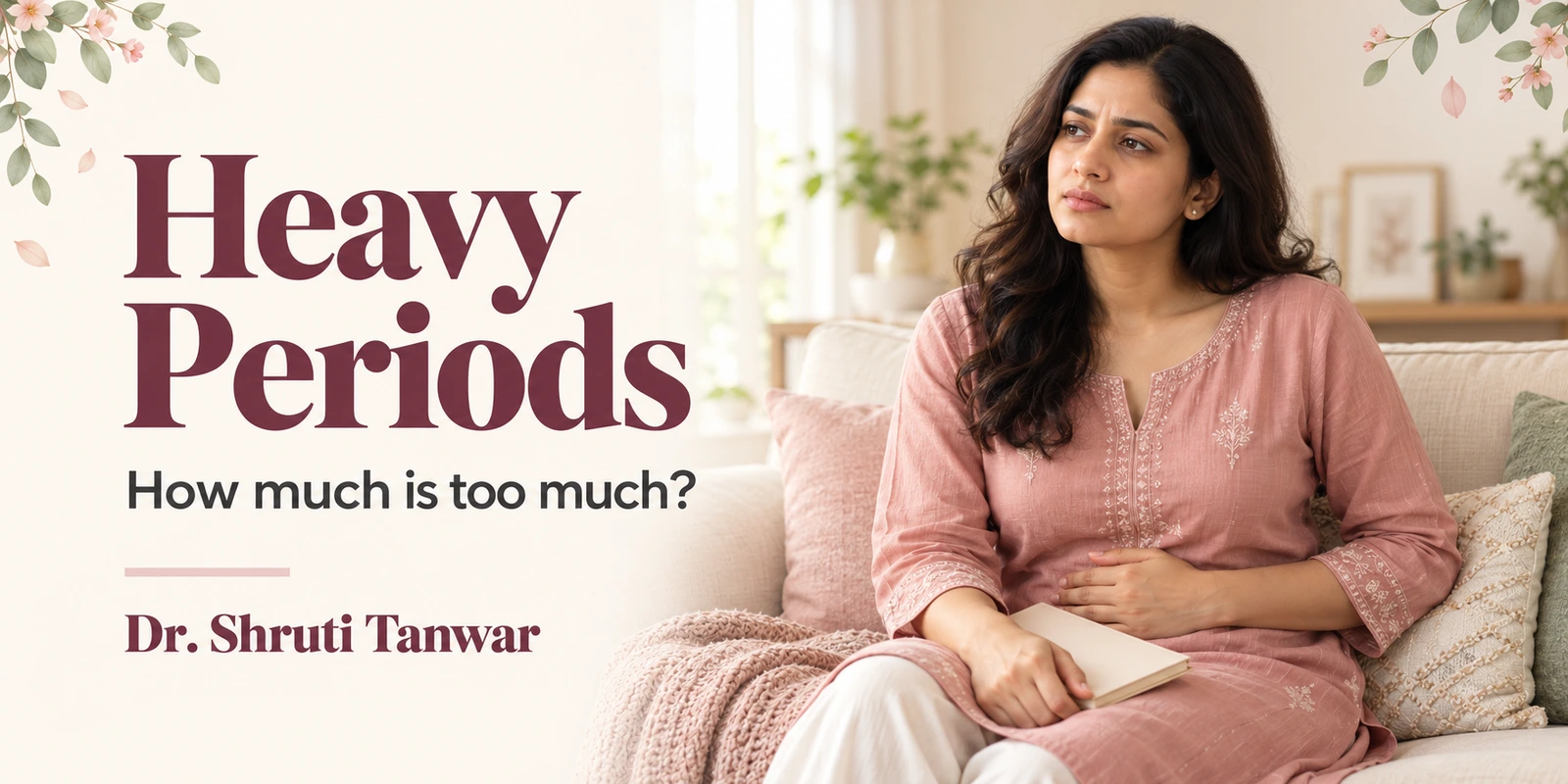
How much bleeding is too much? There is no fixed number. A period counts as heavy when it repeatedly soaks through pads or tampons, lasts more than 7 days, or makes you plan your life around bleeding. If your flow disrupts your days or leaves you exhausted, that alone is reason enough to see a doctor - and heavy periods can be treated.
Doctors call this heavy menstrual bleeding; an older medical name you may see on reports is menorrhagia. Both describe periods heavier or longer than is manageable; neither is a diagnosis in itself. Clinical guidance is clear that what matters is the effect on your life, not a measured volume of blood. This guide explains the practical signs of a heavy flow, what can cause it, why tiredness matters, and what a gynaecologist will ask and check.
Sources: NICE NG88: Heavy menstrual bleeding - assessment and management (opens in a new tab) · NHS: Heavy periods (opens in a new tab)
When to get help: the short version
- Book an appointment if heavy periods are disrupting your life, last more than 7 days, keep soaking through protection, come with larger clots, or leave you feeling drained.
- Get medical advice urgently (same day) if you soak through a pad or tampon every hour for 2 to 3 hours in a row, if you have missed a period and now have unusual bleeding with tummy or pelvic pain, or if you could be pregnant and are bleeding.
- Get emergency help for heavy bleeding with fainting, chest pain, breathlessness or severe dizziness - do not wait to count pads or hours. See the full list.
Sources: MedlinePlus: Vaginal or uterine bleeding (opens in a new tab) · ACOG: Abnormal uterine bleeding (opens in a new tab) · NHS: Bleeding between periods or after sex (opens in a new tab)
How do I know if my periods are heavy?
The amount of bleeding varies widely from woman to woman, and some simply have heavier periods than others. Rather than a single cut-off, doctors look for practical clues like these:
- Soaking through protection quickly. Changing a soaked pad or tampon every 1 to 2 hours, or emptying a menstrual cup more often than its instructions suggest.
- Doubling up. Using two products at once, such as a tampon and a pad.
- Flooding. Bleeding through to clothes or bedding, or sudden gushes.
- Long periods. Bleeding that lasts more than 7 days.
- Larger clots. Regularly passing clots larger than about 2.5 cm, roughly a 10-rupee coin.
- Planning life around your period. Avoiding work, travel or plans, or staying near a bathroom, because of bleeding.
- Feeling drained. Often feeling tired or short of breath.
You do not need all of these signs, and this is not a scoring system. Pads, tampons and cups vary in how much they hold, so a product count alone can never diagnose heavy bleeding. The honest test is simpler: if your periods feel too heavy to live with comfortably, or have clearly changed from your own usual pattern, that is enough to discuss care. One distinction matters: periods that are regularly heavy suit a routine appointment, while a sudden, unusually heavy bleed that keeps soaking through protection hour after hour needs medical advice the same day, as the help box above explains.
Sources: NHS: Heavy periods (opens in a new tab) · NICE NG88: Heavy menstrual bleeding - assessment and management (opens in a new tab) · MedlinePlus: Vaginal or uterine bleeding (opens in a new tab)
Are blood clots during a period always a problem?
No. Some clotting is common on the heaviest day or two of a period, and the occasional small clot does not need investigating. Clots become a useful signal in context: passing clots larger than about 2.5 cm (roughly a 10-rupee coin) again and again counts as a sign of heavy bleeding, especially together with soaking, flooding or bleeding beyond 7 days.
One situation deserves special care: if you have missed a period and are now passing clots with tummy or pelvic pain, do not assume a heavy period has arrived late. Unusual bleeding with pain after a missed period needs urgent assessment because of the small chance of an ectopic pregnancy, even if a home test was negative. Our guide to a late period with a negative pregnancy test explains testing properly.
Sources: NHS: Heavy periods (opens in a new tab) · MedlinePlus: Vaginal or uterine bleeding (opens in a new tab) · NHS: Bleeding between periods or after sex (opens in a new tab)
What can cause heavy periods?
Often no single cause is found, and heavy periods can simply be how your body menstruates, including around life stages such as the first years of periods, after pregnancy, or in the approach to menopause. When there is a cause, these are possibilities a doctor considers, not a symptom-to-diagnosis chart:
- Hormonal and ovulation changes. In cycles where ovulation is irregular, the womb lining can build up for longer and then shed heavily. This is more common in the first years after periods start, in the years approaching menopause, and with conditions that affect ovulation such as PCOS or an underactive thyroid.
- Fibroids and polyps. Fibroids are non-cancerous growths of the womb muscle; polyps are small growths of the womb lining or cervix. Both are common and can make periods heavier or longer.
- Adenomyosis and endometriosis. In adenomyosis, lining-like tissue grows within the womb wall, which can cause heavy, painful periods. Endometriosis and pelvic infection can also change bleeding and cause pain.
- Medicines and bleeding disorders. Blood-thinning medicines can make periods heavier, as can a copper IUD, especially in its first year. Inherited bleeding disorders such as von Willebrand disease are a less common cause; clues include periods heavy ever since they started, a family pattern, easy bruising or frequent nosebleeds. Never stop a prescribed medicine on your own.
- Rarely, more serious causes. Occasionally, abnormal bleeding is an early sign of cancer of the womb lining, mostly seen after menopause. That is a reason a changed pattern deserves a check, not a reason to assume the worst.
Heavy periods are also different from irregular bleeding: bleeding between periods, after sex or after menopause has its own causes and should be checked in its own right. If irregular cycles are your main concern, see our guide to irregular periods and PCOS.
Sources: NHS: Heavy periods (opens in a new tab) · ACOG: Abnormal uterine bleeding (opens in a new tab) · MedlinePlus: Vaginal or uterine bleeding (opens in a new tab) · NHS: Bleeding between periods or after sex (opens in a new tab)
Can heavy periods cause tiredness or anaemia?
Yes. Losing more blood each month means losing more iron, and over time that can lead to iron deficiency anaemia; feeling persistently tired or short of breath is listed among the signs of heavy periods for exactly this reason. Symptoms alone cannot diagnose it, which is why guidelines recommend a full blood count for every woman being assessed for heavy menstrual bleeding.
Iron-rich food supports recovery, but food cannot make up for ongoing heavy blood loss month after month. The useful step is assessing and treating the bleeding itself, alongside any iron treatment your doctor advises.
Sources: NHS: Heavy periods (opens in a new tab) · NICE NG88: Heavy menstrual bleeding - assessment and management (opens in a new tab)
What will a gynaecologist ask and check?
An assessment for heavy periods is mostly a structured conversation, with tests chosen to fit your story rather than a fixed battery:
- 1A conversation first. How heavy and long your periods are, clots, flooding, pain, bleeding between periods or after sex, the effect on your life, your medicines and contraception, your pregnancy plans, and whether heavy periods run in your family or date back to your very first periods.
- 2A simple blood count. Guidelines recommend a full blood count for every woman with heavy periods, to check for anaemia. Other blood tests are added only when your history points to them: clotting tests if periods have been heavy since they started and there is a family history, thyroid tests only if there are other signs of thyroid disease. Routine hormone panels are not recommended.
- 3Examination and tests selected for you, with consent. Treatment can sometimes begin without an internal examination or scan. An ultrasound is suggested when the history or examination points to fibroids or a mass; a hysteroscopy (a thin camera to look inside the womb) when symptoms suggest polyps or a lining problem. Any internal examination or scan goes ahead only if you agree, and not every woman needs every test.
Sources: NICE NG88: Heavy menstrual bleeding - assessment and management (opens in a new tab) · MedlinePlus: Vaginal or uterine bleeding (opens in a new tab) · ACOG: Abnormal uterine bleeding (opens in a new tab)
What treatments might help?
Treatment is a shared decision, and guidelines put your quality of life at the centre of it. The right option depends on the cause found (if any), your health, your preferences and, importantly, your pregnancy plans, so tell your doctor if you are trying or planning to conceive. Options a gynaecologist may discuss include:
- A hormonal intrauterine system (IUS). A small device placed in the womb that thins the lining, often considered first when no major structural cause is found. It usually makes periods much lighter over several cycles and is also a contraceptive.
- Tablets taken only on period days. Tranexamic acid to reduce flow, or anti-inflammatory painkillers that ease cramps and reduce bleeding. Your doctor chooses what is safe for you; this guide deliberately gives no doses.
- Hormonal options. The combined pill or other hormonal methods can lighten and regulate periods if they suit your health.
- Treating a specific cause. Polyps can be removed, and fibroids have treatments ranging from medicines to fibroid removal (myomectomy) or blocking their blood supply, some of which can preserve fertility.
- Surgical options for selected situations. Endometrial ablation (treating the womb lining) or hysterectomy can be discussed when other options have not helped and your family is complete. Pregnancy must be avoided after ablation, and hysterectomy ends periods and fertility, so these are careful, shared decisions.
None of this is self-treatment: these medicines need a prescription and a doctor's judgement about what is safe for you. The options come from UK and US clinical guidance and are tailored to each woman individually, not applied as a fixed sequence. Learn more about menstrual and period disorder care.
Sources: NICE NG88: Heavy menstrual bleeding - assessment and management (opens in a new tab) · NHS: Heavy periods (opens in a new tab) · ACOG: Abnormal uterine bleeding (opens in a new tab)
What should I track before my appointment?
A little preparation makes the consultation far more useful, because your own record beats memory:
- 1Your dates. When each period started and ended over the last 2 to 3 months, in a diary or app.
- 2Your flow on the heaviest days. Roughly how often you change a soaked pad, tampon or cup, any doubling up, and any flooding or leaks.
- 3Clots. How often, and roughly how large.
- 4Other symptoms. Pain, tiredness, breathlessness, dizziness, and any bleeding between periods or after sex.
- 5Your medicines and supplements, including contraception and any blood-thinning medicines.
- 6Your pregnancy plans and questions. Whether you are trying, planning or avoiding pregnancy shapes which treatments fit; bring the two or three questions that matter most.
One important caveat: tracking is for routine appointments. If you are soaking through a pad every hour, feel faint, or are unwell right now, seek help today - do not wait to record another cycle first.
Sources: MedlinePlus: Vaginal or uterine bleeding (opens in a new tab) · ACOG: Abnormal uterine bleeding (opens in a new tab)
When should you see a doctor about heavy periods?
Book an appointment
- Heavy periods are affecting your work, sleep or daily life, or have been heavy for several cycles.
- Periods regularly last more than 7 days, or you regularly pass clots larger than about 2.5 cm.
- You keep soaking through pads or tampons, double up, or bleed through to clothes or bedding.
- Heavy periods come with severe pain, or pain when peeing, passing stool or during sex.
- You feel increasingly tired, weak or short of breath.
- You also bleed between periods or after sex, which needs its own assessment.
You do not need to measure blood loss or tick every sign. Bleeding that disrupts your life is reason enough.
Get medical advice urgently (same day)
- You soak through a pad or tampon every hour for 2 to 3 hours in a row.
- You have missed a period and now have unusual bleeding with tummy or pelvic pain. This can signal an ectopic pregnancy and needs urgent assessment, even if a home pregnancy test was negative.
- You are pregnant, or could be pregnant, and have any vaginal bleeding.
- Bleeding makes you feel weak or light-headed.
- You have any vaginal bleeding after menopause.
Bleeding in pregnancy, after childbirth or after menopause is not a heavy period; each needs its own prompt medical advice.
Get emergency help now
- Heavy bleeding with fainting or feeling about to faint, chest pain, breathlessness, or severe dizziness.
- Bleeding that keeps soaking through a pad or tampon every hour for more than 2 hours and is not slowing.
- Sudden, severe tummy or pelvic pain with bleeding.
Go to the nearest hospital emergency department, or call 112, India’s single emergency number for police, fire and ambulance help. If you feel unwell, do not wait to count pads or hours.
Sources: NHS: Heavy periods (opens in a new tab) · MedlinePlus: Vaginal or uterine bleeding (opens in a new tab) · ACOG: Abnormal uterine bleeding (opens in a new tab) · NHS: Bleeding between periods or after sex (opens in a new tab) · MHA: Emergency Response Support System (112) (opens in a new tab)
Frequently asked questions
How many pads a day is too many?
There is no magic number: pads and tampons vary a lot in how much they absorb, so the pattern matters more than the count. Soaking through every 1 to 2 hours, needing two products at once or bleeding through to clothes all suggest a heavy flow worth discussing. Soaking a pad every hour for 2 to 3 hours in a row needs medical advice the same day.
Are clots during a period always abnormal?
No. Small clots on the heaviest days are common. They are worth checking when they are regularly larger than about 2.5 cm (roughly a 10-rupee coin), or come with soaking, flooding or bleeding that lasts more than 7 days.
What if my period lasts more than 7 days?
Bleeding that regularly lasts more than 7 days is one of the recognised signs of heavy menstrual bleeding and deserves an appointment, especially if it has happened over several cycles or is affecting your life.
Can PCOS cause heavy bleeding?
It can. In PCOS, ovulation is often irregular, so the womb lining can build up over long gaps between periods and then shed heavily. Heavy bleeding with long or irregular gaps deserves a proper assessment rather than guesswork.
Do I need an ultrasound?
Not always. Investigations follow your history and examination: some women start treatment without any scan, an ultrasound is suggested when something points to fibroids or a mass, and a hysteroscopy (a thin camera to look inside the womb) is reserved for specific situations.
Does treatment always mean surgery?
No. Most women start with non-surgical options such as a hormonal intrauterine system, tranexamic acid taken on period days, anti-inflammatory painkillers or hormonal contraception. Surgery is considered when medicines have not helped enough or a specific cause needs treating, and always as a shared decision.
The bottom line
Heavy periods are common, real and treatable, and you do not need to measure anything to deserve help: bleeding that disrupts your life, soaks through protection, lasts beyond a week or leaves you exhausted is reason enough. Most causes are benign, most treatment starts with simple options, and a blood count can catch the anaemia that quietly drains so many women. Browse more periods and PCOS guides.
This article is for general information and education only. It is not a substitute for a personal consultation, diagnosis or treatment from a qualified doctor who knows your individual history.
Are heavy periods taking over your month?
Consult Dr. Shruti Tanwar, Consultant Obstetrician & Gynaecologist, at Niravta Hospital, Sector 88A, Gurugram (Gurgaon), for an unhurried assessment and a treatment plan built around your life and your plans.
Main references
Sources checked on 14 October 2026. Further sources are linked beside each section. Links open in a new tab.