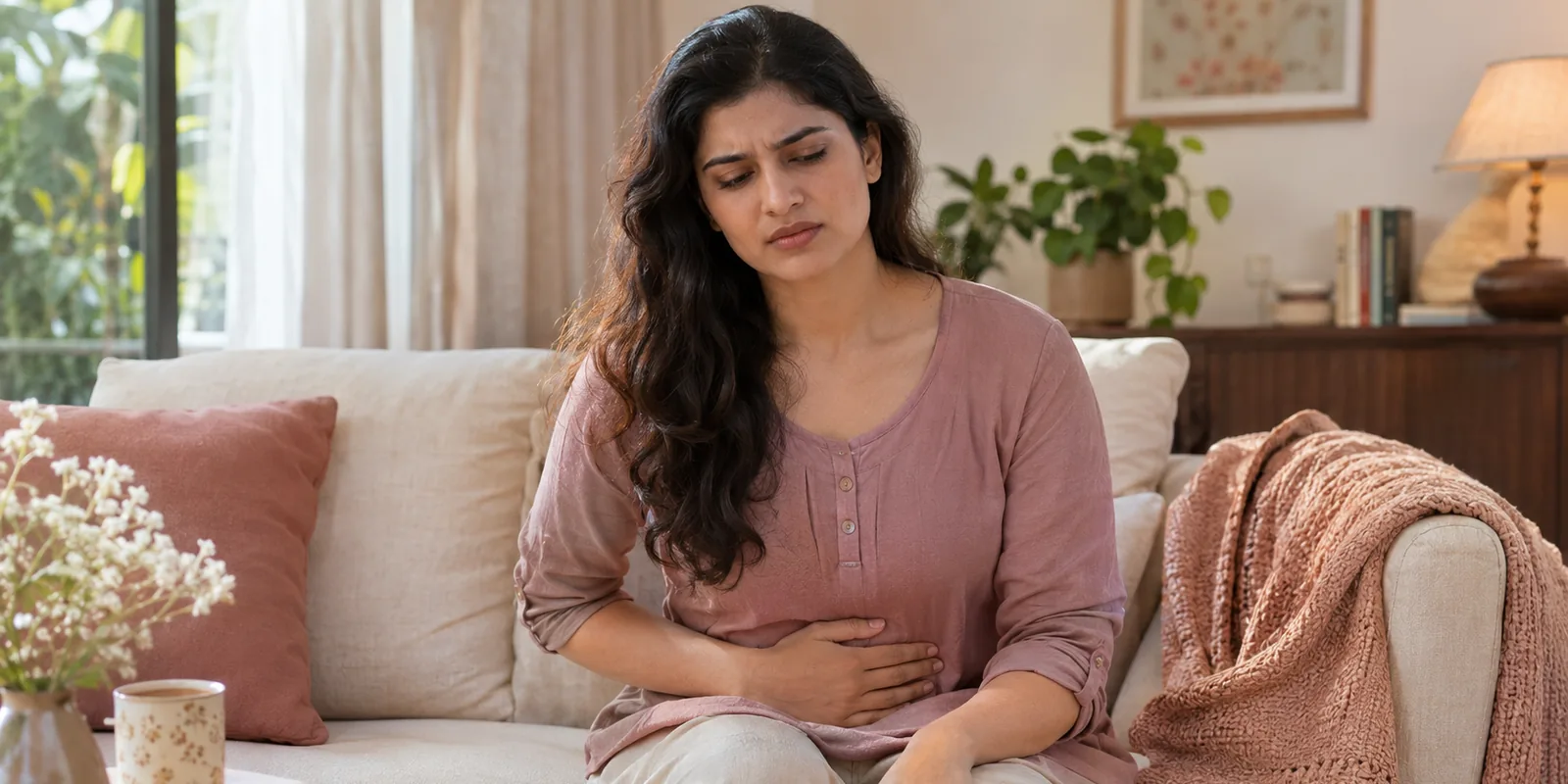
“My cramps make me miss work or college every month. Is that normal?” Period cramps are very common, but pain that regularly keeps you from work, college or your normal day is not something you simply have to put up with. It deserves a proper assessment, and in most cases it can be treated.
More than half of women who have periods get some pain for a day or two each month, and for most it is mild. For some, though, severe period pain arrives with vomiting, loose stools or dizziness and wipes out several days every cycle. Doctors call painful periods dysmenorrhoea. Sometimes it is simply how a body responds to a period; sometimes it points to a condition such as endometriosis. This guide explains the difference, when to get help and what a gynaecologist will check.
Sources: ACOG: Dysmenorrhea - painful periods (opens in a new tab) · ACOG: Painful periods (opens in a new tab)
When to get help for severe period pain
Book an appointment
- Period pain regularly stops you working, studying or doing your usual activities.
- Your periods have become more painful, heavier or irregular.
- You have pain during sex, or when peeing or passing stool.
- You bleed between periods.
- Painkillers no longer give enough relief over several cycles.
You do not need to wait until the pain is unbearable. Pain that keeps disrupting your month is reason enough.
Get medical advice the same day
- Your pelvic or period pain is severe or worse than usual, and painkillers have not helped.
- You have pelvic pain and are pregnant or could be pregnant, for example after a late or missed period.
- You have pelvic pain with a fever, or you feel hot, cold or shivery.
- You have pelvic pain with unusual discharge or bleeding, or pain when peeing.
- You have pelvic pain with vomiting, or you find it difficult to pee or pass stool.
Contact your gynaecologist or a doctor today, or go to a hospital if you cannot be seen.
Go to the emergency department now
- Sudden or severe pelvic pain, pain that keeps getting worse, or pain when you move or someone touches your tummy.
- You faint, or feel dizzy or light-headed.
- Severe pain with heavy bleeding from the vagina.
- Pain in the tip of your shoulder, difficulty breathing, or sudden confusion.
Go to the nearest hospital emergency department or call 112, India’s single emergency number. Do not drive yourself; ask someone to take you, and carry any medicines you take.
Sources: NHS: Period pain (opens in a new tab) · NHS: Pelvic pain (opens in a new tab) · MHA: Emergency Response Support System (112) (opens in a new tab)
What do typical period cramps feel like?
Ordinary period cramps usually start just before or at the start of bleeding. They are felt in the lower tummy and can spread to the back and thighs, as a cramp, a sharp pain or a dull ache. They tend to be worst on the first day and usually ease within one to three days, as the chemicals that make the womb contract (prostaglandins) fall.
A change in your own pattern is often more telling than the pain itself. It is worth discussing if your periods are becoming more painful each year, if the pain starts several days before bleeding or carries on after your period ends, if new pain appears after years of easy periods, or if your periods are also becoming heavier or irregular.
Sources: NHS: Period pain (opens in a new tab) · ACOG: Dysmenorrhea - painful periods (opens in a new tab)
Primary and secondary period pain: what is the difference?
Primary dysmenorrhoea is period pain without an underlying disease. It is caused by prostaglandins made in the womb lining, usually begins soon after periods start, and often becomes milder with age and sometimes after giving birth.
Secondary dysmenorrhoea is period pain caused by a condition of the reproductive organs. It tends to get worse over time and to last longer than ordinary cramps. Possible causes a doctor will consider include:
- Endometriosis. Tissue similar to the womb lining grows outside the womb, for example on the ovaries or behind the womb, and reacts to each cycle. It is the most common medical cause of period pain.
- Adenomyosis. Lining-like tissue grows into the muscle wall of the womb. It is more common in older women who have had children and can cause heavy, painful periods.
- Fibroids. Non-cancerous growths of the womb muscle. Small ones often cause no pain; fibroids in the womb wall can.
- Other causes. Pelvic infection, ovarian cysts, an intrauterine device in its first few months, and bowel or bladder conditions that flare around periods.
Adenomyosis and fibroids can also make periods heavier. If heavy bleeding is part of your picture, our guide to heavy periods explains what counts as too much and what a doctor checks.
Sources: ACOG: Dysmenorrhea - painful periods (opens in a new tab) · ACOG: Painful periods (opens in a new tab) · NHS: Period pain (opens in a new tab) · NHS: Heavy periods (opens in a new tab)
Could my period pain be endometriosis?
Guidelines advise doctors to suspect endometriosis, including in teenagers, when someone has one or more of these endometriosis symptoms:
- Period pain that affects daily life. Cramps that repeatedly keep you from work, college or your usual routine.
- Pelvic pain beyond your period. Pain in the lower tummy that lasts for months, not only on bleeding days.
- Deep pain during or after sex. Pain felt deep inside rather than at the entrance.
- Bowel symptoms around periods, especially pain when passing stool.
- Bladder symptoms around periods, such as pain when peeing or blood in the urine.
- Difficulty getting pregnant together with any of the above.
Endometriosis is also more likely if your mother or sister has it. Still, symptoms alone cannot confirm the cause: the same pain can come from other conditions, so these signs are a reason for assessment, not a diagnosis.
Equally, a normal ultrasound does not rule out endometriosis. Small patches on the lining of the pelvis often do not show on a scan, so a normal report should not end the conversation if your symptoms continue. A blood test called CA125 is not used to diagnose it either.
Sources: NICE NG73: Endometriosis - diagnosis and management (opens in a new tab) · ACOG: Painful periods (opens in a new tab)
What will a gynaecologist ask and check?
An assessment for painful periods starts with your story; tests are chosen to fit it rather than run as a fixed panel:
- 1A conversation first. When the pain comes in your cycle, how strong it is and how it affects your days, your bleeding, pain with sex, bowel or bladder symptoms, medicines tried, pregnancy plans, and family history of endometriosis.
- 2A pregnancy test, where relevant. If there is any chance you could be pregnant, this usually comes first, because pelvic pain in early pregnancy needs a different approach.
- 3An examination, with your consent. A tummy examination and, if you agree and it is suitable for you, an internal examination. If an internal examination is not right for you, an abdominal examination alone is an option.
- 4An ultrasound scan. For suspected endometriosis, guidelines recommend a scan, usually transvaginal (a slim probe placed in the vagina). A scan over the tummy is an alternative if that is not suitable or you prefer not to have it.
Further assessment may be considered if first treatments do not help, if symptoms keep affecting daily life, or if the scan or examination suggests endometriosis affecting the ovaries, bowel or bladder. That might mean a specialist scan, an MRI, or a discussion about laparoscopy (keyhole surgery to look inside the pelvis). None of these is automatic, and you can start treatment while tests are being arranged.
Sources: NICE NG73: Endometriosis - diagnosis and management (opens in a new tab) · ACOG: Dysmenorrhea - painful periods (opens in a new tab) · NHS: Pelvic pain (opens in a new tab)
What can help with period pain?
Simple comfort measures help many women and can be combined with medicines:
- Heat. A hot water bottle wrapped in a cloth or a heat pad on your tummy or lower back, or a warm bath or shower.
- Gentle movement. Walking, yoga, swimming or cycling, and regular exercise through the month.
- Massage and rest. Gently massaging your tummy and back, and getting enough sleep before and during your period.
Medical treatment is chosen for your situation, not applied as one plan for everyone. Options a doctor may discuss include:
- Painkillers. Anti-inflammatory painkillers (NSAIDs) reduce the chemicals behind cramps and work best started at the first sign of your period or pain; paracetamol is another option. NSAIDs are not suitable for everyone, including some people with asthma, stomach ulcers or a bleeding disorder.
- Hormonal treatment. The combined pill, the implant, the injection or a hormonal intrauterine device can ease period pain, including when endometriosis is suspected.
- Treating a specific cause. If a condition such as endometriosis or fibroids is found, treatment is planned around it. Surgery is considered only when other treatments have not helped.
Treatment for suspected endometriosis can start before a diagnosis is confirmed. This guide deliberately gives no doses: ask a doctor or pharmacist what is safe for you, and tell them if you are trying to conceive. Learn more about menstrual and period disorder care.
Sources: NHS: Period pain (opens in a new tab) · ACOG: Dysmenorrhea - painful periods (opens in a new tab) · NICE NG73: Endometriosis - diagnosis and management (opens in a new tab)
What should I note before my appointment?
A simple pain and symptom diary makes the conversation far more useful than memory. Note:
- 1Timing. When the pain starts and stops in relation to your period, over two or three cycles.
- 2Severity. A score from 0 to 10 on your worst day, and whether it is getting worse over time.
- 3Effect on daily life. Days of work or college missed, plans cancelled, or sleep lost.
- 4Bleeding. Period dates, how heavy the flow is, and any bleeding between periods or after sex.
- 5Medicines tried. What you took, when you started it, and how much it helped.
- 6Reports. Earlier ultrasound scans, blood tests or discharge summaries.
Tracking is for routine appointments. If your pain is severe now, follow the care guide above instead of waiting for another cycle.
Sources: NICE NG73: Endometriosis - diagnosis and management (opens in a new tab) · ACOG: Dysmenorrhea - painful periods (opens in a new tab)
Frequently asked questions
Is it normal to vomit or feel dizzy with period pain?
Nausea, vomiting, loose stools, headache and dizziness can come with severe period pain, so they are worth mentioning to a doctor. Fainting, or vomiting with fever or worsening pain, needs urgent help rather than waiting for the period to end.
Will period pain go away after marriage or after having a baby?
Common period pain often eases with age and sometimes after giving birth, but marriage or pregnancy is not a treatment. If your pain is affecting your life now, get it checked now.
Can I keep taking painkillers every month?
Many women use painkillers on period days with good effect. But if a few months of regular use is not giving enough relief, that is a reason for further assessment rather than simply taking more tablets.
Do I need a laparoscopy to know whether I have endometriosis?
Not necessarily. Laparoscopy (keyhole surgery to look inside the pelvis) can confirm endometriosis, and it may be discussed if symptoms continue despite treatment or scans show a problem. But treatment can start when endometriosis is suspected, without surgery, so an operation is not a required first step.
Does endometriosis mean I will not be able to get pregnant?
No, it does not mean that. Endometriosis can make conceiving harder for some women, so if you are trying to get pregnant, tell your doctor early because it changes the plan. Hormonal treatments used for endometriosis pain have no permanent negative effect on later fertility.
Sources: ACOG: Dysmenorrhea - painful periods (opens in a new tab) · NICE NG73: Endometriosis - diagnosis and management (opens in a new tab) · NHS: Pelvic pain (opens in a new tab)
The bottom line
Severe period pain that costs you days of work or college every month is not something to quietly endure. It is often treatable, and when simple steps are not enough, it deserves a closer look for causes such as endometriosis, even after a normal scan. Browse more periods and PCOS guides.
This article is for general information and education only. It is not a substitute for a personal consultation, diagnosis or treatment from a qualified doctor who knows your individual history.
Is period pain taking days out of your month?
Consult Dr. Shruti Tanwar, Consultant Obstetrician & Gynaecologist, at Niravta Hospital, Sector 88A, Gurugram (Gurgaon), for an unhurried assessment and a plan that fits your life.
Main references
Sources checked on 12 November 2026. Further sources are linked beside each section. Links open in a new tab.