

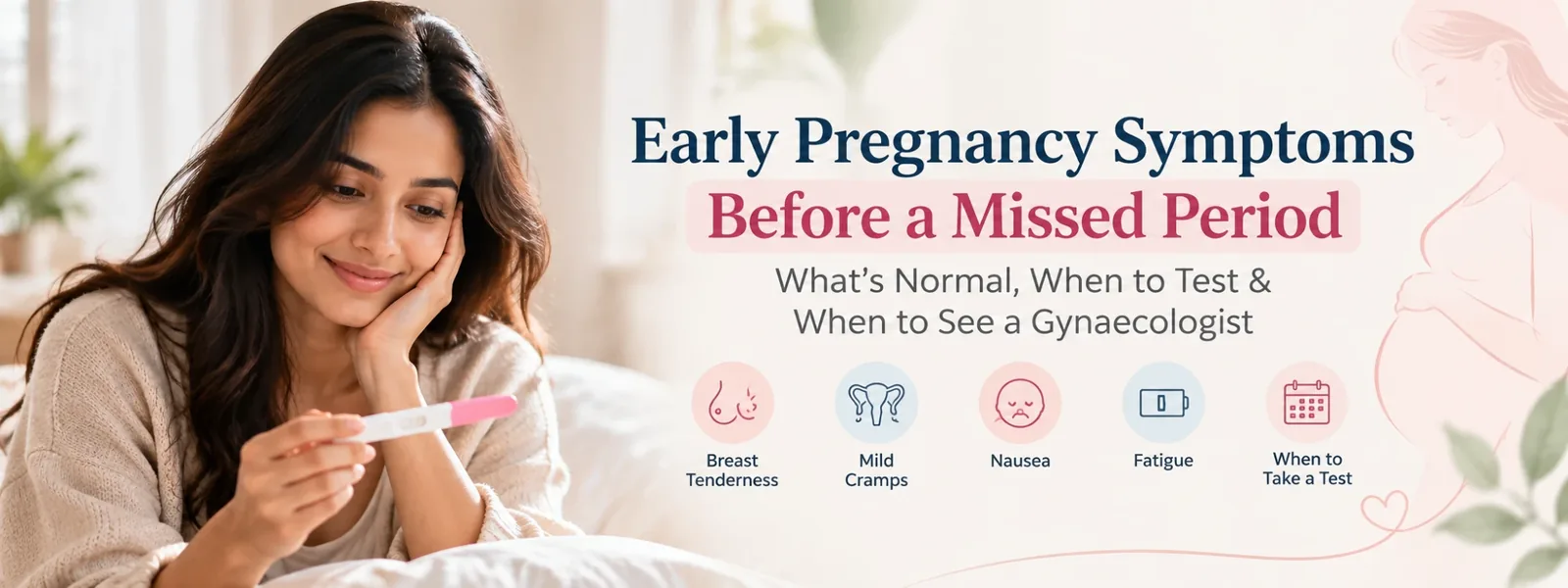
If you are trying to conceive, or worried that you might be, the days before a period is due can feel very long. Every twinge gets analysed.
So, are early pregnancy symptoms before a missed period real? Yes, for some women. After implantation the pregnancy hormone hCG begins to rise and progesterone stays high, which can cause breast tenderness, tiredness, mild cramping or bloating before the period is due. But the same hormones produce the same feelings before a normal period, so symptoms alone cannot tell PMS and pregnancy apart. A home pregnancy test is far more reliable than any symptom.
Can you have pregnancy symptoms before a missed period? Yes. Some women notice breast tenderness, tiredness, mild cramping, bloating, nausea or light spotting in the days before their period is due. These symptoms are driven by progesterone, which also rises before a normal period, so they cannot confirm pregnancy. A home pregnancy test from the day your period is due is far more reliable.
Can you have pregnancy symptoms before a missed period?
Yes, although they are neither universal nor specific. What happens in the two weeks between ovulation and the expected period explains why.
- Progesterone rises after every ovulation. The corpus luteum produces it to prepare the womb lining, pregnant or not, causing premenstrual breast tenderness, bloating and tiredness.
- Implantation happens 6 to 12 days after ovulation, most often on days 8 to 10. Only then does the body start making hCG, the hormone pregnancy tests detect.
- hCG starts from almost nothing and roughly doubles every two to three days, so just before the expected period it is still low: early symptoms are mild and early tests can be negative.
- If you are pregnant, progesterone does not fall. hCG keeps the corpus luteum going, so the symptoms progesterone causes persist or intensify instead of fading with a period.
Symptoms vary because hormone levels and sensitivity differ, and because a woman hoping to conceive notices sensations others would ignore. Not imaginary, but unreliable as evidence.
How early can pregnancy symptoms start?
Pregnancy-specific symptoms can only begin after implantation, when hCG production starts. Most women notice them around or after the missed period: in a prospective study that followed women from before conception, about half had a symptom by the end of week 5 and nearly all by week 8.
| Cycle stage | What may be happening | Possible symptoms | Can a pregnancy test detect it? |
|---|---|---|---|
| Ovulation (about day 14) | Egg released; progesterone starts rising | Mild one-sided twinge | No |
| Fertilisation (within 24 hours) | Sperm meets egg | None | No |
| Implantation (6 to 12 days after ovulation) | Embryo embeds; hCG production begins | Possibly light spotting or cramps; most feel nothing | Not reliably |
| Rising hCG (days before the expected period) | hCG doubling every 2 to 3 days | Breast tenderness, tiredness, bloating | Sensitive tests may; false negatives common |
| Expected period (14 days after ovulation) | hCG usually detectable in urine | No period; symptoms persist | Yes, in most pregnancies |
| One week after missed period (5 weeks) | hCG rising steadily | Nausea, tiredness, frequent urination | Yes, highly reliable |
Timings assume a 28-day cycle. A longer, shorter or irregular cycle shifts every stage, including the right day to test.
10 early pregnancy symptoms before a missed period
For each symptom: why it happens, when it appears, and whether PMS can cause the same thing, because in nearly every case it can.
1. Breast tenderness
Why. Progesterone and oestrogen increase breast blood flow and start preparing the milk ducts: heavy, sore or tingly breasts.
When. From about a week after ovulation; often the earliest symptom.
PMS too? Yes, very commonly. PMS soreness eases once the period starts; in pregnancy it persists.
2. Mild cramping
Why. Light, period-like cramps low in the pelvis as the lining responds to implantation and the uterus begins to change.
When. Around implantation and just before the expected period.
PMS too? Yes, often identically. Severe or one-sided cramps, or cramps with bleeding, need assessment.
3. Light spotting
Why. Pink or brown spotting near the due date, often attributed to implantation, though the link is weaker than claimed (see below).
When. Roughly 10 to 14 days after ovulation.
PMS too? Spotting can also be a period starting slowly. It is never proof of pregnancy.
4. Fatigue
Why. Progesterone is sedating, and the body is building blood volume, so tiredness is out of proportion to activity.
When. Within a week or two of conception; marked by 6 to 8 weeks.
PMS too? Yes, especially with poor sleep or iron deficiency.
5. Nausea
Why. Rising hCG and oestrogen are thought to trigger it, at any time of day, often as queasiness or food aversions rather than vomiting.
When. Most often from about 6 weeks, 2 weeks after the missed period; occasionally earlier.
PMS too? Occasionally; before a period is due it is more often PMS or a stomach upset.
6. Increased sensitivity to smells
Why. A heightened sense of smell is a recognised early symptom, linked to rising oestrogen and hCG and closely tied to nausea.
When. Usually with nausea from 5 to 6 weeks; sometimes before the missed period.
PMS too? Less typical, but possible, and not specific enough to confirm pregnancy.
7. Bloating
Why. Progesterone relaxes the gut, so digestion slows and gas builds up. Clothes feel tight long before the uterus has changed.
When. From soon after ovulation.
PMS too? Yes. One of the commonest premenstrual symptoms, and indistinguishable.
8. Increased vaginal discharge
Why. Higher oestrogen increases cervical mucus, giving a thin, milky-white, mild-smelling discharge (leukorrhoea) that is normal.
When. From the first weeks, increasing through pregnancy.
PMS too? Discharge changes in every cycle, so this alone proves little. Itchy, green or foul-smelling discharge suggests infection.
9. Frequent urination
Why. hCG and rising blood volume mean the kidneys filter more fluid. Later the uterus presses on the bladder.
When. Usually from 6 to 8 weeks; sometimes before the missed period.
PMS too? Less typical. Drinking more or a urinary infection can also cause it; burning needs a check.
10. Mood changes
Why. Rapid hormonal shifts affect brain chemistry, and tiredness and uncertainty add to it: tearfulness, irritability or unusual sensitivity.
When. From the first weeks, often before the missed period.
PMS too? Yes. Mood change is a defining feature of PMS and cannot separate the two.
Implantation bleeding vs period
Implantation bleeding is described as light spotting as the embryo embeds, around 10 to 14 days after ovulation, close to when a period would be due, which is why the two get confused.
| Feature | Implantation-related spotting | Period |
|---|---|---|
| Timing | A few days before, or around, the expected period | On or after the expected date |
| Colour | Pink or light brown | Bright red at first, then darker |
| Flow | Spotting only; no pad needed | Light to heavy; pads or tampons needed |
| Duration | A few hours to 1 or 2 days | 3 to 7 days |
| Cramping | Mild or none | Mild to significant, easing after the first day or two |
| Clots | None | Small clots can be normal |
A word of caution: the link between spotting and implantation is widely repeated but weakly supported. Studies that tracked women daily from conception found no clustering of spotting around implantation day, and most pregnancies implant without bleeding. So spotting does not reliably confirm implantation, and its absence says nothing against pregnancy. If spotting replaces your period, take a test; if bleeding is heavier than spotting with a positive test, see your gynaecologist.
PMS vs early pregnancy symptoms
PMS and early pregnancy share the same starting point, a progesterone surge after ovulation, so the symptom lists overlap almost completely.
| Symptom | PMS | Early pregnancy |
|---|---|---|
| Breast tenderness | Common; eases as the period starts | Common; persists and increases |
| Cramps | Common just before and during the period | Mild cramping possible; severe or one-sided pain is not typical |
| Bloating | Very common | Very common |
| Fatigue | Common; resolves with the period | Common; more marked, continues |
| Nausea | Uncommon | Uncommon before the missed period; common from 6 weeks |
| Mood changes | Defining feature; lifts with the period | Common; continues |
| Spotting | May precede the full period | Light spotting possible; no period follows |
Symptoms alone cannot reliably distinguish PMS from pregnancy. The useful difference is what happens next: with PMS the symptoms fade as the period arrives; in pregnancy the period does not arrive. If your period is late, test.
Pregnancy symptoms week 1 - what does “week 1” actually mean?
“First week pregnancy symptoms” is one of the most searched pregnancy phrases, and one of the most misunderstood, because of how pregnancy is dated.
- Pregnancy is counted from the first day of your last menstrual period (LMP), not from conception.
- Week 1 is your period, week 2 the lead-up to ovulation; conception happens around day 14.
- Implantation happens in week 3. When your period is due you are already 4 weeks pregnant.
- So in clinical week 1 you cannot have pregnancy symptoms, because conception has not yet happened.
Women asking about week 1 usually mean the first week after conception, clinical week 3, when most feel nothing: implantation is only just happening and hCG is barely detectable. The earliest genuine symptoms belong to week 4, the week of the missed period.
When should you take a pregnancy test?
From the first day of your missed period, when most home tests are highly accurate if used correctly. Testing earlier is possible, but false negatives become likelier with every day before the period is due.
Best time to take a pregnancy test: on or after the first day of your missed period, with first-morning urine. If you must test earlier, use a sensitive “early result” test and expect to repeat it. If the result is negative and no period arrives, repeat after 48 hours. If your cycles are irregular, test at least 21 days after unprotected sex.
- Why early tests miss. Just after implantation hCG is tiny. In one study, about 1 in 10 pregnancies had not even implanted by the first day of the missed period, so an early negative does not rule pregnancy out.
- Sensitivity varies. Standard tests detect about 20 to 25 mIU/mL of hCG; “early result” tests about 10 mIU/mL. These may turn positive a few days before the period, but less reliably than the packaging implies.
- Use first-morning urine and read within the time window. Overnight urine is more concentrated. A faint line within the window usually counts as positive; a line appearing after it may be an evaporation line.
- If negative, repeat after 48 hours. hCG rises fast, so a negative can become clearly positive. A blood beta-hCG, repeated after 48 hours, detects pregnancy a few days earlier and shows whether it is rising normally.
Pregnancy test negative but still having symptoms
A negative test with persistent symptoms is one of the commonest questions I am asked. Most explanations are not alarming.
- Testing too early. The most likely reason. Repeat after 48 hours, and again a week after the missed period if still negative.
- Late ovulation. Stress, illness, travel or PCOS can delay ovulation, so implantation and the hCG rise are later too.
- Irregular cycles or miscounted dates. If cycles vary, the expected date is a guess. Test 21 days after the last unprotected sex instead.
- PMS. If the period is simply late, premenstrual symptoms persist until it arrives.
- Hormonal changes and stress. Thyroid problems, raised prolactin, PCOS, weight change, heavy exercise and stress can all delay a period and mimic pregnancy symptoms.
If your period is more than a week late and tests stay negative, do not keep testing indefinitely. A gynaecologist can arrange a blood beta-hCG and look for the cause; see my guide on a late period but negative pregnancy test.
Positive pregnancy test - what should you do next?
A positive home test, even a faint line, is almost always a true positive, because hCG is only produced in pregnancy (rare exceptions: a very recent pregnancy loss or fertility injections containing hCG). What I suggest next:
- 1Book a consultation with a gynaecologist or obstetrician, ideally within the first week or two. Note the first day of your last period and, if known, your ovulation date: this is how the pregnancy is dated before ultrasound refines it.
- 2Start folic acid if you have not already: 400 micrograms daily until at least 12 weeks. Women with diabetes, epilepsy, a BMI over 30 or a previous baby with a neural tube defect need a higher prescribed dose.
- 3Review your medicines, but do not stop prescribed ones abruptly. Bring a list of everything you take, including supplements; some need changing, and stopping others suddenly can do more harm than continuing.
- 4Plan your antenatal care. The first visit covers history, blood pressure, weight and booking blood tests (blood group, haemoglobin, thyroid, blood sugar, infections). Stop smoking and alcohol now, and limit caffeine.
- 5Discuss the timing of your first ultrasound. Many obstetricians scan at 6 to 8 weeks to confirm the pregnancy is in the uterus and developing, then a dating and screening scan at 11 to 14 weeks. With pain, bleeding, a previous ectopic pregnancy or IVF, the first scan is usually earlier. There is no single right week for everyone.
When should you see a gynaecologist?
Routine consultation
Arrange a routine obstetric consultation in the first few weeks after a positive test, or sooner if you have diabetes, thyroid disease, hypertension or epilepsy, take regular medication, have had previous miscarriages, or are over 35. Women looking for a gynaecologist in Gurugram or near Dwarka Expressway can seek an obstetric consultation after a positive pregnancy test for pregnancy confirmation, dating and personalised antenatal advice. More on pregnancy care in Gurugram.
Urgent consultation
See a doctor the same day if you have a positive test with pain or bleeding; a late period with severe or one-sided pelvic pain, even if the test is negative; a history of ectopic pregnancy or tubal surgery; or conceived with an intrauterine device in place. These need early assessment to confirm where the pregnancy is.
Warning signs that need urgent medical attention
Most early pregnancies never reach this list. It separates “mention it at my appointment” from “get seen now”.
Contact your obstetrician immediately or go to the nearest emergency department if you have:
- Heavy bleeding soaking a pad in an hour, or passing clots or tissue.
- Severe pelvic or lower abdominal pain, especially sharp pain on one side.
- Fainting, severe dizziness or a racing heart.
- Shoulder-tip pain (where the shoulder meets the neck), especially with bleeding or abdominal pain.
- Persistent vomiting that stops you keeping fluids down.
- Fever, chills or foul-smelling discharge.
One-sided pain, shoulder-tip pain and faintness can indicate an ectopic pregnancy, where the embryo implants outside the uterus, usually in a fallopian tube. It is uncommon, and most early pregnancy pain is benign, but because it can cause serious internal bleeding it is always assessed urgently, usually with an early ultrasound.
Frequently asked questions about early pregnancy symptoms
Can pregnancy symptoms start before a missed period?
Yes. Some women notice breast tenderness, tiredness, bloating, mild cramps or queasiness in the days before their period is due. These are driven by progesterone, which rises after every ovulation, so PMS causes the same feelings. Symptoms before a missed period cannot confirm pregnancy. A home pregnancy test from the day your period is due is far more reliable.
What is usually the first sign of pregnancy?
For most women, the first clear sign is a missed period. Before that, the most commonly reported early symptoms are breast tenderness and tiredness, sometimes with mild cramping or bloating. Nausea usually comes later, around 6 weeks of pregnancy. Many women have no symptoms at all until well after the missed period, which is entirely normal.
Can pregnancy symptoms begin 7 days after conception?
It is possible but uncommon. Implantation usually happens 6 to 12 days after ovulation, and the pregnancy hormone hCG only begins to rise after that. Around 7 days after conception, some women may have light spotting or mild cramps, but most feel nothing specific. Symptoms that start this early are more likely to be premenstrual or related to anticipation.
Can you feel pregnant before your period is due?
Some women describe simply knowing, and a few do have genuine early symptoms from rising progesterone and hCG. But the same hormonal shifts happen before a period, and women hoping to conceive often notice normal body sensations more closely. Feeling pregnant is a reason to test, not a diagnosis. Only a pregnancy test or a scan can confirm it.
How do you tell PMS from pregnancy?
You usually cannot, from symptoms alone. Breast tenderness, cramps, bloating, tiredness, food cravings and mood changes happen in both. Slight clues toward pregnancy include tenderness that keeps increasing rather than easing, spotting instead of a full period, and nausea or a heightened sense of smell. The only reliable way to tell is to wait for your period or take a pregnancy test.
When should I take a pregnancy test?
The best time is from the first day of your missed period, ideally with first-morning urine. Testing earlier is possible with sensitive tests, but false negatives are common. If your cycles are irregular, test at least 21 days after unprotected sex. If the result is negative and your period has still not come, repeat the test after 48 hours.
Can a pregnancy test be negative if I am pregnant?
Yes. The commonest reason is testing too early, before hCG has risen enough to be detected. Late ovulation, miscounting your cycle, very dilute urine, or reading the result outside the recommended window can also cause a false negative. If your period does not arrive, repeat the test after 48 hours. A blood test for beta-hCG can confirm an early pregnancy sooner.
Does implantation always cause bleeding?
No. Most women have no bleeding at all when the embryo implants. Light pink or brown spotting around the time a period is due is sometimes attributed to implantation, but studies that tracked women day by day have not shown spotting clustering around the day of implantation. Spotting neither confirms nor rules out pregnancy; a test does.
Are cramps normal in early pregnancy?
Mild, period-like cramping or a pulling sensation low in the pelvis is common in early pregnancy as the uterus begins to change and grow. It should be mild and settle on its own. Cramping that is severe, worsening, one-sided, or accompanied by bleeding, dizziness or shoulder-tip pain is not normal and needs urgent assessment to rule out ectopic pregnancy.
How soon after a positive test should I see a gynaecologist?
Book a routine appointment within the first week or two of a positive test, so that the pregnancy can be dated, folic acid and medications reviewed, and an early scan planned at the right time. See a doctor sooner, without waiting, if you have pain, bleeding, a previous ectopic pregnancy, or a medical condition such as diabetes, thyroid disease or epilepsy.
Can nausea start before a missed period?
Occasionally, yes, but it is unusual. Pregnancy nausea most often begins around 6 weeks of pregnancy, roughly 2 weeks after the missed period, and is linked to rising hCG and oestrogen. Queasiness before a period is due can also be caused by PMS, anxiety or a stomach upset. Nausea on its own does not confirm pregnancy.
Can you be pregnant without early symptoms?
Yes, and it is common. Many women feel completely normal until after the missed period, and some have very few symptoms throughout the first trimester. The absence of symptoms does not mean something is wrong with the pregnancy. Symptom patterns also vary between pregnancies in the same woman. If your period is late, test rather than wait for symptoms.
The bottom line
Early pregnancy symptoms before a missed period are real for some women, absent for many, and indistinguishable from PMS for almost everyone. Test from the day your period is due and repeat after 48 hours if negative. If you have a positive pregnancy test, persistent symptoms, unusual bleeding or questions about early pregnancy, a consultation with an obstetrician can confirm the pregnancy, estimate gestational age and guide the next steps.
This article is for general information and education only. It is not a substitute for a personal consultation, diagnosis or treatment from a qualified doctor who knows your individual history.
Written and medically reviewed by
Dr. Shruti Tanwar
MBBS, MS (Obstetrics & Gynaecology), FMAS, DMAS · Minimal Access Surgery
Consultant Obstetrician & Gynaecologist at Niravta Hospital, Sector 88A, Gurugram, near Dwarka Expressway. Her practice covers antenatal and high-risk pregnancy care, fertility and PCOS, and laparoscopic gynaecological surgery.
Positive test, or not sure what your symptoms mean?
Consult Dr. Shruti Tanwar, Obstetrician & Gynaecologist in Gurugram, for pregnancy confirmation, dating and early antenatal advice at Niravta Hospital, Sector 88A.